Entre Ríos
Explora Nuestras Provincias y sus Riquezas is part of Argentina al Mundo, alongside Argentine Delights, Guía AD-Gourmet and Chefs Argentinos al Mundo.
Entre Ríos, a land between rivers. The Paraná and the Uruguay embrace it, and between them unfold green ridges, gallery forests and the islands of the Delta. In El Palmar, yatay palms paint the horizon, and hot springs rise from its soil. Land of colonies and Jewish gauchos, of the Gualeguaychú carnival and the chamarrita. Honey from Maciá, pecans, citrus and the largest poultry industry in the country. Entre Ríos is not crossed: it is enjoyed. Entre Ríos is the calm that flows with its rivers.

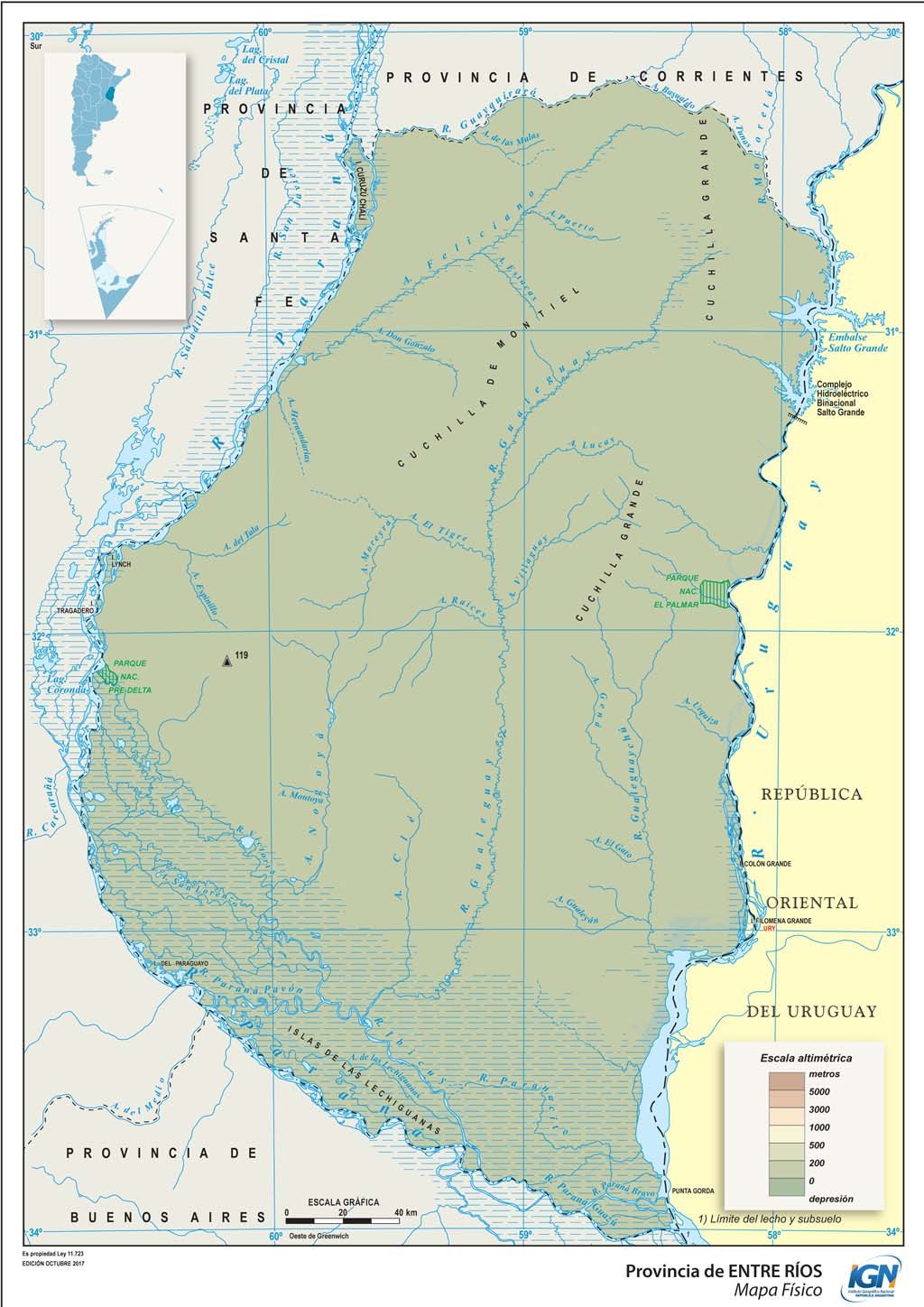
Political map · Source: IGN
- Capital
- Paraná
- Region
- Pampas
- Area
- 78,781 km²
- Population · 2022 Census
- 1,425,578 inhabitants · 18.1 hab/km²
- Women · Men
- 51.3 % · 48.7 %
- Median age
- 32 years
- By age
- 0 to 14 years: 22.1 % · 15 to 64 years: 65.8 % · 65 years and over: 12.1 %
- Climate
- Humid temperate in the south; humid subtropical in the north.
- Demonym
- entrerriano/a
- Founding of the capital
- 25 June 1813 (no formal founding: date it was raised to the status of villa)
- Status
- Province predating the 1853 National Constitution
- Departments
- 17
- Born in another province · abroad
- 11.1 % · 1.0 %
Sources: INDEC, 2022 National Census (final results) · INDEC / IGN (area) · Provincialization laws · IGN (political division).
- Mean annual temperature
- 18.3 °C
- Annual rainfall
- 1,155 mm
- Mean maximum · warmest month
- 31.2 °C · January
- Mean minimum · coldest month
- 7.2 °C · July
Source: Servicio Meteorológico Nacional (SMN), climatological standard normals 1991–2020, station Paraná Aero, submitted to the World Meteorological Organization.
- Main rivers
- Paraná · Uruguay · Gualeguay · Gualeguaychú
- Ecoregions
- Espinal · Paraná Delta and Islands · Pampas
- Main cities
- Paraná · Concordia · Gualeguaychú · Concepción del Uruguay · Villaguay
Sources: Secretaría de Infraestructura y Política Hídrica de la Nación, river basins · Ministerio de Ambiente de la Nación, ecoregions of Argentina · INDEC, 2022 National Census (population by department).
- Provincial natural monuments
- Scarlet-headed blackbird, ultramarine grosbeak, saffron-cowled blackbird and yellow cardinal · Ley 11.078
Gray brocket, maned wolf and marsh deer · Ley 11.079
Sources: Gobierno de Entre Ríos, Secretaría de Ambiente, Dirección de Áreas Naturales Protegidas.
- Hotel guests · 2024
- 189,563 in the surveyed towns: Gualeguaychú 105,546 · Paraná 84,017 · 12.0 % from abroad
- National parks
- El Palmar · Pre-Delta
Sources: INDEC and Secretaría de Turismo de la Nación, Hotel Occupancy Survey (hotels and other lodgings) · Administración de Parques Nacionales.
- Airport
- General Urquiza · 41,195 passengers in 2025
- Scheduled flights · 2025
- Aeroparque 41,195 passengers
- National routes
- RN 12 · RN 14 · RN 18 · RN 127 · RN 130 · RN 131 · RN 135 · RN 136 · RN 174
- International border crossings
- Uruguay 11 (Gualeguaychú–Fray Bentos, Colón–Paysandu, Concordia–Salto)
Sources: Secretaría de Turismo de la Nación, Air connectivity, with ANAC data · Instituto Geográfico Nacional (IGN), national road network and international crossings.
- From Paraná to the City of Buenos Aires, by road
- 480 km
To the other provincial capitals, by road
- Santa Fe 31 km
- Córdoba 361 km
- La Plata 555 km
- Resistencia 576 km
- Corrientes 590 km
- Santiago del Estero 638 km
- San Luis 656 km
- Formosa 744 km
- La Rioja 796 km
- San Miguel de Tucumán 798 km
- San Fernando del Valle de Catamarca 801 km
- Posadas 820 km
- Santa Rosa 841 km
- San Juan 861 km
- Mendoza 916 km
- Salta 1,105 km
- San Salvador de Jujuy 1,138 km
- Neuquén 1,378 km
- Viedma 1,435 km
- Rawson 1,696 km
- Río Gallegos 2,876 km
- Ushuaia 3,469 km
Source: Government of the Argentine Republic (argentina.gob.ar), road distances between provincial capitals.
- National festivals
- Fiesta Nacional de Jineteada y Folklore · January · Diamante
Festival Nacional del Chamamé · February · Federal - Traditional festivals
- Carnaval del País · January and February · Gualeguaychú
Sources: Res. Secretaría de Turismo de la Nación 106/1989 · Decreto provincial 3.186/2025 · Ley provincial 8.358.
- Share of the national economy · 2024
- 2.8 % · rank 7 of 24
- Growth 2004–2024
- +55 % · the country, +42 %
- Main activities
- Trade 22.8 % · Agriculture and livestock 18.7 % · Food and beverages 8.3 % · Public administration 7.4 %
Source: ECLAC and Ministerio de Economía de la Nación, Provincial breakdown of gross value added, 2004 base (2023 and 2024, preliminary data).
Natural wealth
The territory that defines it
Entre Ríos is, as its name says, a land between rivers: the Paraná to the west and the Uruguay to the east embrace it and turn it into an island of green rolling hills, streams and gallery forests. To the south opens the Paraná Delta, a labyrinth of islands and channels protected by Pre-Delta National Park. On the Uruguay, El Palmar National Park protects the yatay palm groves, also a Ramsar site. And from its subsoil rise hot springs that gave life to the Uruguay River thermal corridor, from Federación to Colón.
- Parque Nacional El Palmar (1965)
- Parque Nacional Pre-Delta (1992)
Source: Argentine National Parks Administration (SIB-APN).
- Palmar Yatay (2011) · 21,450 ha
- Delta del Paraná (2015) · 243,126 ha · shared with Santa Fe
Source: Argentine Undersecretariat of Environment, Ramsar Sites Network. Official year of designation and area.
Human wealth
The living figures
Entre Ríos is river, colony and celebration. The Carnaval del País, in Gualeguaychú, is one of Argentina's great carnivals; Concordia celebrates the National Citrus Festival, and Maciá the National Beekeeping Festival. Its towns keep the memory of the immigrant colonies, and its music is chamamé and chamarrita. At the table, river fish such as sábalo and surubí, honey, citrus and pecans.
- Before the conquest · the Charrúa, Chaná and Minuán inhabit the ridges and riverbanks; their heritage is still alive in the province
- 19th century · Justo José de Urquiza, governor of Entre Ríos, wins at Caseros in 1852 and opens the way to the National Constitution; his residence, the Palacio San José, is today a National Historic Monument
- Late 19th century · the Jewish agricultural colonies arrive, the origin of the "Jewish gauchos" portrayed by Alberto Gerchunoff, who grew up in those colonies, alongside Volga German, Swiss and Italian settlers
Sources: Government of Entre Ríos · National Monuments Commission.
18,693 people identify as Indigenous or as descendants of Indigenous or native peoples: 1.3 % of the province's population. They belong to 43 different peoples, and 1,989 (10.6 %) speak or understand the language of their people. The five largest peoples are:
- Charrúa · 3,031
- Guaraní · 2,632
- Chana · 528
- Mapuche · 505
- Qom/Toba · 494
Source: INDEC, 2022 National Population, Household and Housing Census, final results. Population in private dwellings.
Productive wealth
What it produces and exports
Entre Ríos is the country's leading poultry province and an agri-food powerhouse: cereals and oilseeds, rice, citrus from the Uruguay River, cattle, honey and pecans, of which it is the national leader. China is today its main export destination.
USD 2,115 million, 30.8 % more than in 2024: 2.4 % of the national total and 3.4 % of the Pampas region.
- Primary products · USD 1,257 M
- Manufactures of agricultural origin · USD 673 M
- Manufactures of industrial origin · USD 114 M
- Fuels and energy · USD 72 M
Main destinations: China (USD 561 M, 26.5 %), Brazil (USD 221 M), European Union (USD 151 M) and Uruguay (USD 129 M). Main products: cereals (USD 821 M), meat and meat preparations (USD 425 M), oilseeds and oleaginous fruits (USD 343 M) and electricity (amount withheld for statistical confidentiality).
Source: INDEC, Provincial origin of exports. Goods. Year 2025 (provisional data) and annex tables.
Public sector · in 2025, 378 million birds were slaughtered in Entre Ríos, the country's leading province. It accounts for 47.3 % of the country's poultry establishments and 56.5 % of its broiler farms.
Private sector · according to the Entre Ríos Grain Exchange, with SENASA data, the province accounts for more than half of the country's chicken slaughter.
Sources: Public sector, General Directorate of Statistics and Censuses of Entre Ríos · Secretariat of Agriculture, 2025 Poultry Yearbook · Private sector, Bolsa de Cereales de Entre Ríos.
Entre Ríos is the country's second honey-producing province, after Buenos Aires. Every year, Gobernador Maciá, in the department of Tala, hosts the National Beekeeping Festival and Mercosur Beekeeping Expo: born as a provincial festival in 1995, it was declared national in 2011 and is today a benchmark for beekeeping in Latin America, with international honey competitions.
Sources: Argentine Ministry of Tourism · Argentine Chamber of Deputies · Municipality of Gobernador Maciá.
Public sector · Entre Ríos is the country's leading producer, with about 60 % of the national area and production: between 4,000 and 5,000 hectares out of a total of more than 10,000. About 90 % is exported. The pecan reached Argentina thanks to Domingo Faustino Sarmiento, initially as an ornamental tree.
Sources: SENASA · Argentine Secretariat of Agriculture, Alimentos Argentinos magazine.
4,351,929 head as of 31 December 2024: 8.4 % of the national cattle stock.
Source: SENASA, stock as of 31/12/2024, in Secretariat of Agriculture, Provincial cattle profile 2024.
CONICET has four research units in the province, together with the Universidad Nacional de Entre Ríos and the Universidad Autónoma de Entre Ríos.
Source: CONICET, 2025 Management Report.
Space to embed one or more 45s–1min capsules about the province.
To experience it on the ground — restaurants, hotels, events, geolocation — the app.
Open the Argentina al Mundo app