Formosa
Explora Nuestras Provincias y sus Riquezas is part of Argentina al Mundo, alongside Argentine Delights, Guía AD-Gourmet and Chefs Argentinos al Mundo.
Formosa, the beautiful. A land of embracing rivers, the Paraguay and the Pilcomayo, and of the Bañado La Estrella, where trees emerge from the water like an endless mirror. Forest, palm groves and immense skies. Land of Qom, Pilagá and Wichí peoples, of hands that weave chaguar and palm. Shared tereré, warm chipá and the warmth of its people. Formosa is not told: it is discovered. Formosa is nature that embraces you.


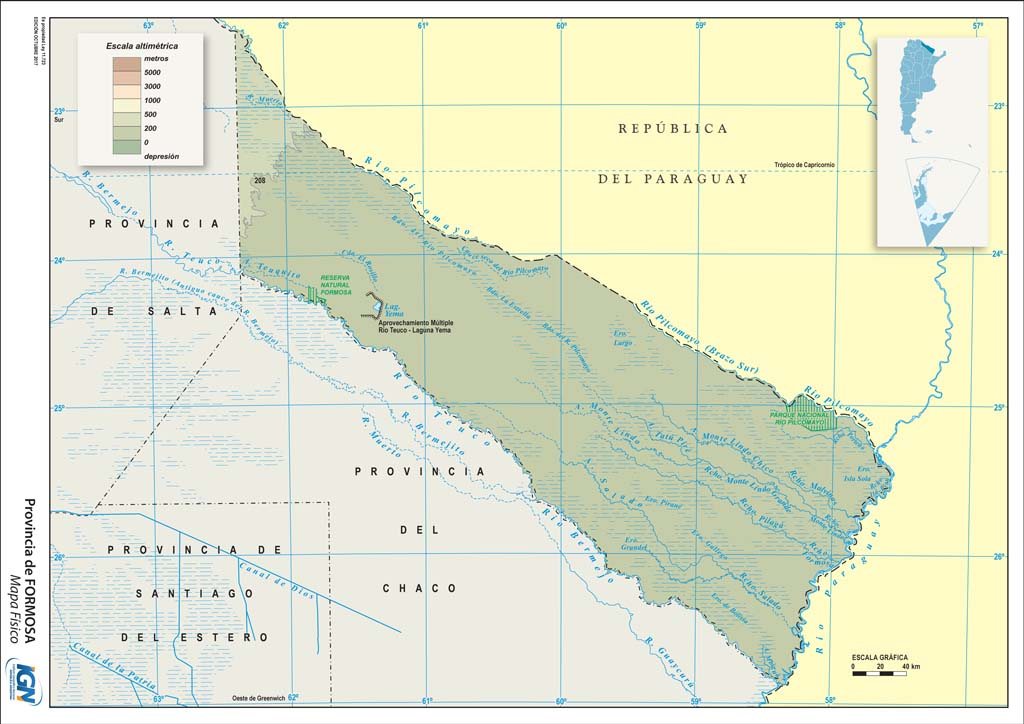
Political map · Source: IGN
- Capital
- Formosa
- Region
- Northeast
- Area
- 72,066 km²
- Population · 2022 Census
- 607,419 inhabitants · 8.4 hab/km²
- Women · Men
- 51.1 % · 48.9 %
- Median age
- 29 years
- By age
- 0 to 14 years: 25.2 % · 15 to 64 years: 65.5 % · 65 years and over: 9.3 %
- Climate
- Subtropical with a dry season; humid in the east and semi-arid in the west.
- Demonym
- formoseño/a
- Founding of the capital
- 8 April 1879
- Status
- Province since 1955 · Ley 14.408
- Departments
- 9
- Born in another province · abroad
- 8.7 % · 2.8 %
Sources: INDEC, 2022 National Census (final results) · INDEC / IGN (area) · Provincialization laws · IGN (political division).
- Mean annual temperature
- 22.5 °C
- Annual rainfall
- 1,406 mm
- Mean maximum · warmest month
- 34.1 °C · January
- Mean minimum · coldest month
- 11.5 °C · July
Source: Servicio Meteorológico Nacional (SMN), climatological standard normals 1991–2020, station Formosa Aero, submitted to the World Meteorological Organization.
- Main rivers
- Paraguay · Pilcomayo · Bermejo
- Ecoregions
- Humid Chaco · Dry Chaco
- Main cities
- Formosa · Clorinda · Pirané
Sources: Secretaría de Infraestructura y Política Hídrica de la Nación, river basins · Ministerio de Ambiente de la Nación, ecoregions of Argentina · INDEC, 2022 National Census (population by department).
- Provincial natural monuments
- Tapir · Ley 1.582 (2012)
Azara’s night monkey · Ley 1.582 (2012)
Bare-faced curassow · Ley 1.582 (2012)
Strange-tailed tyrant · Ley 1.583 (2012)
Jaguar · Ley 1.673 (2018)
Giant anteater · Ley 1.673 (2018)
Maned wolf · Ley 1.673 (2018)
Marsh deer · Ley 1.673 (2018)
Sources: Legislatura de la Provincia de Formosa · Boletín Oficial de la Provincia de Formosa.
- Hotel guests · 2024
- 72,103 in Formosa · 16.7 % from abroad
- National park
- Río Pilcomayo
Sources: INDEC and Secretaría de Turismo de la Nación, Hotel Occupancy Survey (hotels and other lodgings) · Administración de Parques Nacionales.
- Airport
- Internacional de Formosa/El Pucú · 90,410 passengers in 2025
- Scheduled flights · 2025
- Aeroparque 86,176 · Ezeiza 4,234 passengers
- National routes
- RN 11 · RN 81 · RN 86 · RN 95
- International border crossings
- Paraguay 9 (Clorinda–Puerto José A. Falcon)
Sources: Secretaría de Turismo de la Nación, Air connectivity, with ANAC data · Instituto Geográfico Nacional (IGN), national road network and international crossings.
- From Formosa to the City of Buenos Aires, by road
- 1,191 km
To the other provincial capitals, by road
- Resistencia 168 km
- Corrientes 191 km
- Posadas 506 km
- Santa Fe 713 km
- Paraná 744 km
- Santiago del Estero 776 km
- San Miguel de Tucumán 936 km
- Salta 948 km
- San Salvador de Jujuy 960 km
- San Fernando del Valle de Catamarca 988 km
- Córdoba 1,043 km
- La Rioja 1,136 km
- La Plata 1,253 km
- San Luis 1,463 km
- Santa Rosa 1,523 km
- San Juan 1,543 km
- Mendoza 1,710 km
- Neuquén 2,060 km
- Viedma 2,117 km
- Rawson 2,378 km
- Río Gallegos 3,558 km
- Ushuaia 4,151 km
Source: Government of the Argentine Republic (argentina.gob.ar), road distances between provincial capitals.
- National festivals
- Fiesta Nacional del Pomelo · September · Laguna Blanca
Sources: Ley nacional 27.128.
- Share of the national economy · 2024
- 0.5 % · rank 24 of 24
- Growth 2004–2024
- +35 % · the country, +42 %
- Main activities
- Trade 17.9 % · Public administration 12.0 % · Public education 9.9 % · Communications 9.4 %
Source: ECLAC and Ministerio de Economía de la Nación, Provincial breakdown of gross value added, 2004 base (2023 and 2024, preliminary data).
Natural wealth
The territory that defines it
Formosa is the Gran Chaco in its purest form. To the east, the humid Chaco: marshes, lagoons and gallery forests along the Paraguay River, with Río Pilcomayo National Park and the Laguna Oca Biosphere Reserve at the gates of the capital. To the west, the forest becomes dry and thorny. In the center lies the Bañado La Estrella, one of the country's great wetlands, where dead trees rise from the water among birds, caimans and capybaras.
- Parque Nacional Río Pilcomayo (1951)
Source: Argentine National Parks Administration (SIB-APN).
- Parque Nacional Río Pilcomayo (1992) · 51,889 ha
Source: Argentine Undersecretariat of Environment, Ramsar Sites Network. Official year of designation and area.
Human wealth
The living figures
Formosa is a land of borders and encounters. Almost eight in every hundred people from Formosa identify as Indigenous —mainly Wichí, Qom and Pilagá— and they keep their languages alive, with crafts in chaguar fiber, palm and palo santo wood as their hallmark. The closeness to Paraguay is lived at the table —chipá, sopa paraguaya, mbejú and river fish— and in music, from chamamé to polka. Laguna Blanca celebrates the National Grapefruit Festival every year.
- Before the conquest · hunting, fishing and gathering peoples of the Gran Chaco —Qom, Pilagá, Wichí, Nivaclé— inhabit the territory, which remains outside colonial rule for centuries
- 1870 · at the end of the War of the Triple Alliance, Paraguay renounces its claims south of the Pilcomayo River
- 1879 · Luis Jorge Fontana founds the city of Formosa
- 1884 · the National Territories Law creates the Governorate of Formosa
- 1947 · the Rincón Bomba massacre against the Pilagá people, near Las Lomitas. In 2019 the federal courts declared it a crime against humanity, and in 2020 the Federal Court of Appeals deemed it genocide
- 1955 · Formosa becomes a province
Sources: Government of the Argentine Republic · Federal Court No. 1 of Formosa (2019) and Federal Court of Appeals of Resistencia (2020).
47,459 people identify as Indigenous or as descendants of Indigenous or native peoples: 7.8 % of the province's population. They belong to 34 different peoples, and 41,260 (86.9 %) speak or understand the language of their people. The five largest peoples are:
- Wichi · 22,321
- Qom/Toba · 14,870
- Pilagá · 5,833
- Guaraní · 594
- Chulupí/Nivaclé · 450
Source: INDEC, 2022 National Population, Household and Housing Census, final results. Population in private dwellings.
Productive wealth
What it produces and exports
Formosa's economy rests on cattle breeding, which covers much of the territory, and on agriculture in the east: rice, corn, grapefruit and bananas. To the west, in Ramón Lista, it produces oil in fields operated by the provincial company. Brazil is today its main export destination.
USD 29 million, 18.2 % more than in 2024: less than 0.1 % of the national total and 2.6 % of the Northeast.
- Primary products · USD 24 M
- Manufactures of agricultural origin · USD 5 M
Main destinations: Brazil (USD 6 M, 21.9 %), European Union (USD 4 M), China (USD 4 M) and Chile (USD 2 M). Main products: cereals (USD 19 M), other products of animal origin (amount withheld for statistical confidentiality), oilseeds and oleaginous fruits (USD 4 M) and tanning and dyeing extracts (amount withheld for statistical confidentiality).
Source: INDEC, Provincial origin of exports. Goods. Year 2025 (provisional data) and annex tables.
1,596,904 head as of 31 December 2024: 3.1 % of the national cattle stock.
Source: SENASA, stock as of 31/12/2024, in Secretariat of Agriculture, Provincial cattle profile 2024.
Three areas in production in the department of Ramón Lista —Palmar Largo, active since 1983, El Chivil and Surubí— operated by REFSA, a provincial state company.
Sources: REFSA · Government of the Province of Formosa.
Laguna Naineck and Laguna Blanca were for decades one of the country's main banana-growing hubs.
Private sector · according to the Federación Agraria, Laguna Naineck branch, the activity is going through a crisis due to competition from imported fruit, and the cultivated area has fallen drastically.
Source: Federación Agraria Argentina, Laguna Naineck branch.
CIT Formosa, a Research and Transfer Center created in 2013 by CONICET, the Government of Formosa and the Universidad Nacional de Formosa, with sites in Formosa and Laguna Blanca.
Source: CONICET, 2025 Management Report.
Data on mining and hydrocarbons is included for information purposes only, as part of the province's productive profile. Explora Nuestras Provincias y sus Riquezas does not promote extractive activity.
Space to embed one or more 45s–1min capsules about the province.
To experience it on the ground — restaurants, hotels, events, geolocation — the app.
Open the Argentina al Mundo app