Jujuy
Explora Nuestras Provincias y sus Riquezas is part of Argentina al Mundo, alongside Argentine Delights, Guía AD-Gourmet and Chefs Argentinos al Mundo.
Jujuy. From San Salvador to La Quiaca, from the Yungas to the Salinas Grandes, with the Hornocal at its heart: the cradle of civilization that has inhabited this land for more than ten thousand years. An artery that breathes and beats in every copla, in the silence of the altiplano, in the hills that change color with the light. To visit Jujuy is to travel in time and to meet your inner self. Jujuy is not toured: it is felt. Jujuy is living energy.

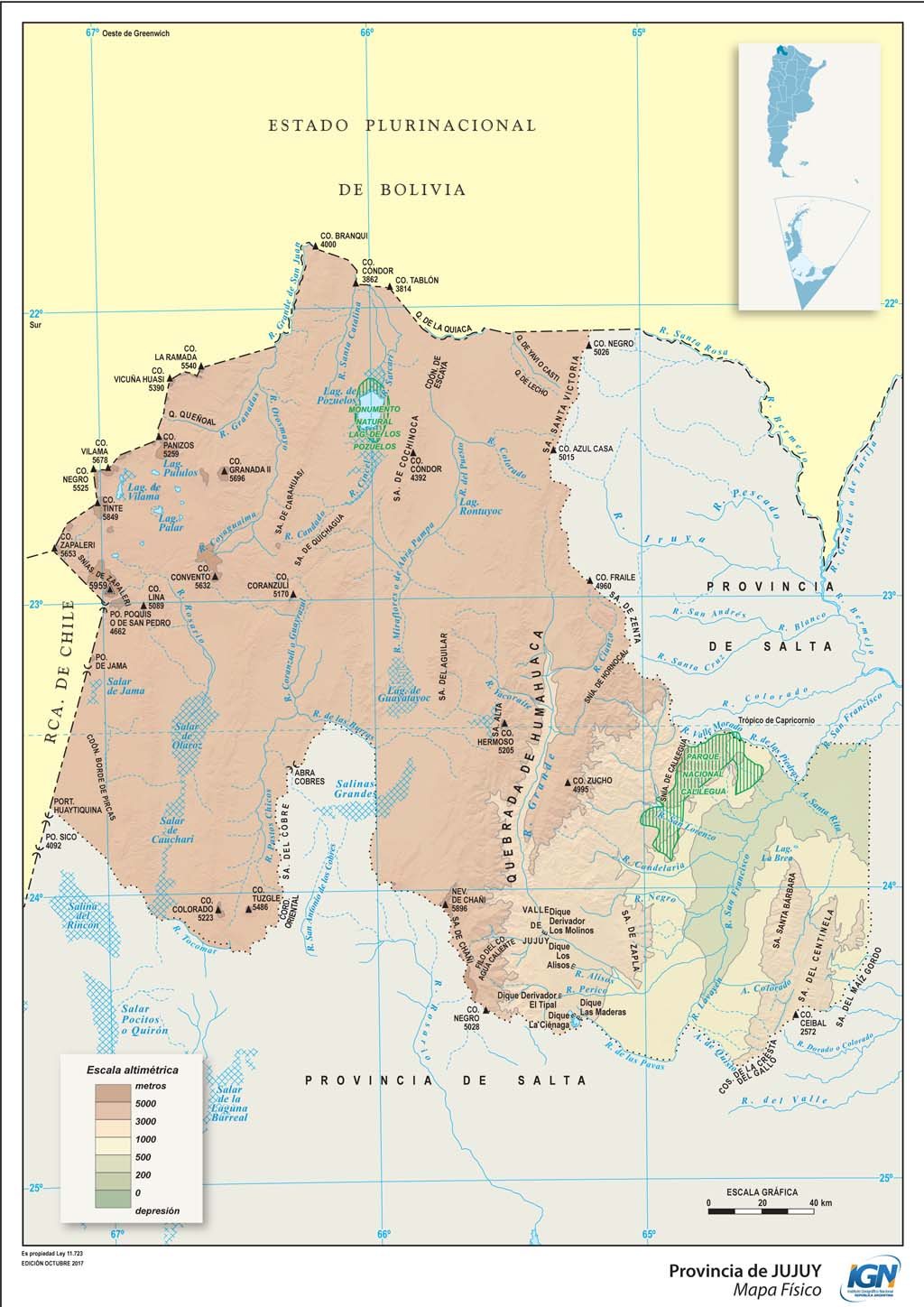
Political map · Source: IGN
- Capital
- San Salvador de Jujuy
- Region
- Northwest
- Area
- 53,219 km²
- Population · 2022 Census
- 811,611 inhabitants · 15.3 hab/km²
- Women · Men
- 51.5 % · 48.5 %
- Median age
- 31 years
- By age
- 0 to 14 years: 23.4 % · 15 to 64 years: 66.7 % · 65 years and over: 9.9 %
- Climate
- Cold and arid at altitude in the Puna; temperate and dry in the gorges and valleys; humid subtropical in the yungas.
- Demonym
- jujeño/a
- Founding of the capital
- 19 April 1593
- World Heritage (UNESCO)
- Quebrada de Humahuaca (2003) · Qhapaq Ñan, Sistema Vial Andino (2014)
- Status
- Province predating the 1853 National Constitution
- Departments
- 16
- Born in another province · abroad
- 14.7 % · 3.7 %
Sources: INDEC, 2022 National Census (final results) · INDEC / IGN (area). World Heritage: UNESCO, World Heritage List · Provincialization laws · IGN (political division).
- Mean annual temperature
- 16.7 °C
- Annual rainfall
- 951 mm
- Mean maximum · warmest month
- 27.7 °C · December
- Mean minimum · coldest month
- 4.5 °C · July
Source: Servicio Meteorológico Nacional (SMN), climatological standard normals 1991–2020, station Jujuy UN, submitted to the World Meteorological Organization.
- Highest point
- Nevado de Chañi · 5,896 m · on the border with Salta
- Main rivers
- Grande · San Francisco · Lavayén · Grande de San Juan
- Ecoregions
- High Andes · Puna · Monte of Sierras and Bolsones · Yungas Forest · Dry Chaco
- Main cities
- San Salvador de Jujuy · Perico · Libertador General San Martín · San Pedro de Jujuy · Palpalá
Sources: Instituto Geográfico Nacional (IGN), El Ojo del Cóndor · Secretaría de Infraestructura y Política Hídrica de la Nación, river basins · Ministerio de Ambiente de la Nación, ecoregions of Argentina · INDEC, 2022 National Census (population by department).
- Provincial flower
- Pink lapacho blossom · Ley 4.383 (1988) · celebrated on 1 September
- Provincial natural monuments
- Taruca · Ley 5.405 (2004)
Jaguar · Ley 5.984 (2016)
Andean cat · Ley 6.268 (2022)
Andean condor · Ley 6.318 (2022)
Tapir · Ley 6.332 (2022)
Black-and-chestnut eagle · Ley 6.387 (2024)
Sources: Legislatura de Jujuy · Boletín Oficial de la Provincia de Jujuy · Gobierno de la Provincia de Jujuy.
- Hotel guests · 2024
- 136,081 in San Salvador de Jujuy · 11.3 % from abroad
- Hotel guests · January to November 2025
- Quebrada de Humahuaca 172,177 · Yungas 25,186 · Valles 16,661
- National park
- Calilegua
Sources: INDEC and Secretaría de Turismo de la Nación, Hotel Occupancy Survey (hotels and other lodgings) · Administración de Parques Nacionales.
- Airport
- Internacional Gobernador Horacio Guzmán · 484,598 passengers in 2025
- Scheduled flights · 2025
- Aeroparque 311,462 · Ezeiza 136,724 · Córdoba 32,894 · Asunción 3,518 passengers
- National routes
- RN 9 · RN 34 · RN 40 · RN 51 · RN 52 · RN 66
- International border crossings
- Chile 3 (Jama) · Bolivia 1 (La Quiaca–Villazón)
Sources: Secretaría de Turismo de la Nación, Air connectivity, with ANAC data · Instituto Geográfico Nacional (IGN), national road network and international crossings.
- From San Salvador de Jujuy to the City of Buenos Aires, by road
- 1,543 km
To the other provincial capitals, by road
- Salta 99 km
- San Miguel de Tucumán 340 km
- Santiago del Estero 500 km
- San Fernando del Valle de Catamarca 572 km
- La Rioja 770 km
- Resistencia 860 km
- Corrientes 883 km
- Córdoba 930 km
- Formosa 960 km
- Santa Fe 1,107 km
- Paraná 1,138 km
- Posadas 1,198 km
- San Juan 1,220 km
- San Luis 1,320 km
- Mendoza 1,345 km
- Santa Rosa 1,530 km
- La Plata 1,645 km
- Viedma 2,124 km
- Neuquén 2,200 km
- Rawson 2,385 km
- Río Gallegos 3,565 km
- Ushuaia 4,158 km
Source: Government of the Argentine Republic (argentina.gob.ar), road distances between provincial capitals.
- National festivals
- Fiesta Nacional de los Estudiantes · September · San Salvador de Jujuy
Fiesta Nacional de la Pachamama · 1 August - Traditional festivals
- Carnaval de la Quebrada · February or March
Toreo de la Vincha en Casabindo · 15 August
Manca Fiesta en La Quiaca · October
Sources: Ley nacional 25.933 · Ley nacional 26.891 · Ley provincial 6.456 · Ministerio de Cultura y Turismo de Jujuy.
- Share of the national economy · 2024
- 1.0 % · rank 19 of 24
- Growth 2004–2024
- +66 % · the country, +42 %
- Main activities
- Communications 12.7 % · Trade 11.9 % · Public administration 9.4 % · Metal mining 7.6 %
Source: ECLAC and Ministerio de Economía de la Nación, Provincial breakdown of gross value added, 2004 base (2023 and 2024, preliminary data).
Natural wealth
The territory that defines it
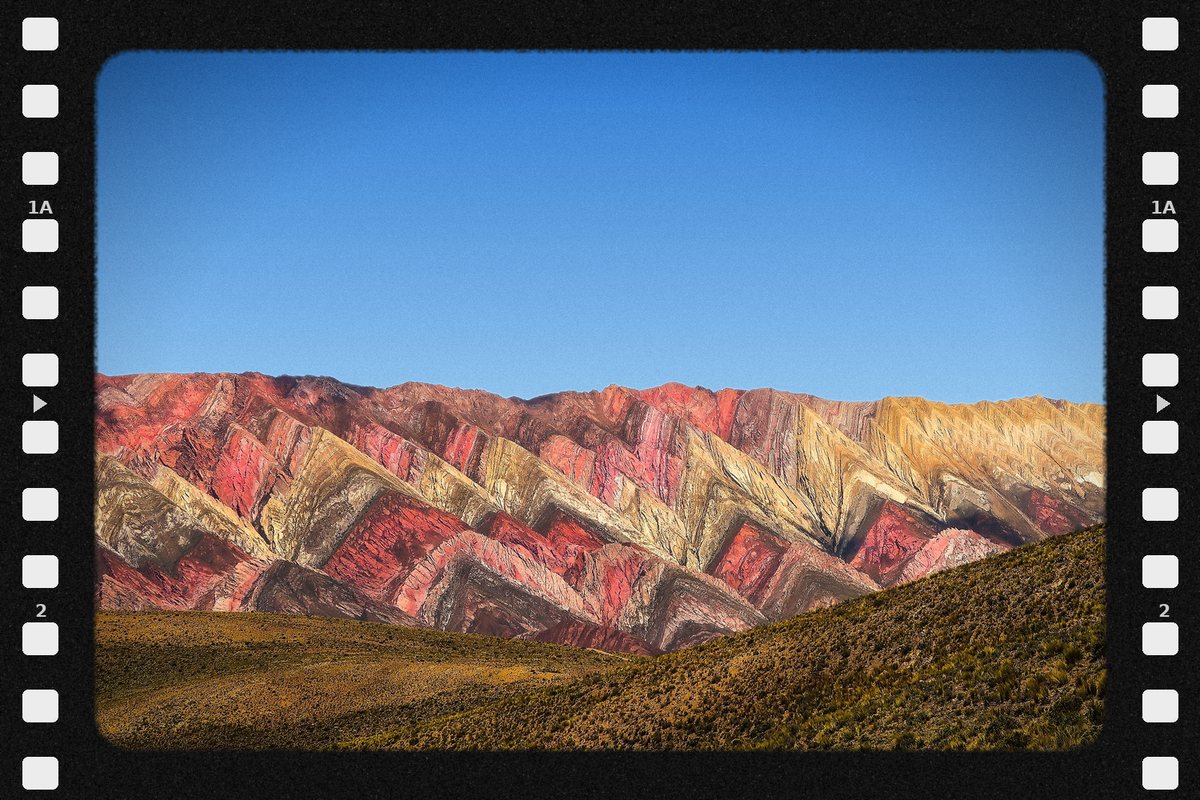
Jujuy brings together four worlds in a single territory. The Puna, a high plateau above 3,000 meters, of salt flats, lagoons and vicuñas. The Quebrada de Humahuaca, a valley of colored hills declared a World Heritage Site. The temperate valleys of the center, where the capital lies. And the Yungas, a mountain rainforest protected by Calilegua National Park. In a few hours on the road you go from high-altitude desert to humid forest. Among its emblematic landscapes are the Hill of Seven Colors in Purmamarca, the Serranía de Hornocal in Humahuaca and the Laguna de los Pozuelos, a refuge for flamingos in the heart of the Puna.
- Parque Nacional Calilegua (1979)
Source: Argentine National Parks Administration (SIB-APN).
- Laguna de los Pozuelos (1992) · 16,224 ha
- Lagunas de Vilama (2000) · 157,000 ha
Source: Argentine Undersecretariat of Environment, Ramsar Sites Network. Official year of designation and area.
Human wealth
The living figures
Jujuy's identity is Andean. One in ten inhabitants identifies as Indigenous —the Kolla are the largest people— and that heritage lives in everyday life: the offering to the Pachamama every 1 August, the Carnival of the Quebrada with its comparsas and the unearthing of the devil, the coplas and bagualas sung to the beat of the caja drum, the music of sikus, quenas and erkes. Jujuy's table grows from the same root: corn, Andean potatoes, quinoa and llama meat, in tamales, humitas, locro and picantes. San Salvador de Jujuy hosts the National Students' Festival, and La Quiaca the Manca Fiesta, the great gathering of potters of the Puna.
- More than 11,000 years ago · the first hunter-gatherers arrive. At Inca Cueva 4 (Humahuaca) they left one of the most important rock-art sites of Argentina's first inhabitants, dated to 9,900 radiocarbon years
- 5,000 to 6,000 years ago · in the Puna the domestication of the guanaco begins, the origin of the llama
- About 3,000 years ago · pottery arrives, and with it the first villages of herders and farmers
- 12th to 16th centuries · the Pucará de Tilcara, a fortified settlement of the Tilcaras, an Omaguaca group of the Quebrada; it reached its peak occupation in Inca times
- Late 14th and early 15th centuries · the Inca Empire incorporates the territory into the Collasuyu and integrates it into its road network, the Qhapaq Ñan
- 16th century · Viltipoco, curaca of Tilcara, leads the Indigenous resistance to the Spanish conquest. In 1593 San Salvador de Jujuy is founded
Sources: Aschero, C., El sitio ICc-4, Estudios Atacameños 7 · Otero, C., Instituto Interdisciplinario Tilcara (FFyL-UBA) and CONICET · García, Greco and Moralejo, Bayesian chronology of the Inca expansion.
- Tomás Lipán · music · born in Purmamarca
- Bruno Arias · music · born in El Carmen (1979)
- Ariel Ortega · football · born in Libertador General San Martín (1974) · World Cups 1994, 1998 and 2002 · silver medal, Atlanta 1996 Olympic Games
- José Daniel Valencia · football · world champion, Argentina 1978
Sources: careers published in national and provincial press.
81,538 people identify as Indigenous or as descendants of Indigenous or native peoples: 10.1 % of the province's population. They belong to 47 different peoples, and 30,116 (36.9 %) speak or understand the language of their people. The five largest peoples are:
- Kolla · 32,276
- Omaguaca · 9,173
- Guaraní · 7,522
- Atacama · 3,960
- Quechua · 3,492
Source: INDEC, 2022 National Population, Household and Housing Census, final results. Population in private dwellings.
Productive wealth
What it produces and exports
Jujuy has two complementary economies. In the Puna, lithium, silver and the sun: two lithium carbonate operations in production and the Cauchari Solar Park. In the valleys and the Yungas, sugarcane, Virginia tobacco and vegetables. China is today its main buyer.
USD 1,259 million, 17.2 % more than in 2024: 1.4 % of the national total and 25.1 % of the Northwest.
- Manufactures of industrial origin · USD 571 M
- Primary products · USD 523 M
- Manufactures of agricultural origin · USD 165 M
Main destinations: China (USD 758 M, 60.2 %), European Union (USD 122 M), United States (USD 80 M) and Chile (USD 73 M). Main products: chemicals —lithium— (amount withheld for statistical confidentiality), metal ores (USD 428 M), sugar (USD 140 M) and unmanufactured tobacco (USD 44 M).
Source: INDEC, Provincial origin of exports. Goods. Year 2025 (provisional data) and annex tables.
- Cauchari-Olaroz, Susques · Minera Exar (Lithium Argentina and Ganfeng; 8.5 % JEMSE) · 34,100 t of lithium carbonate in 2025 (25,400 t in 2024)
- Olaroz, Susques · Sales de Jujuy (Rio Tinto 66.5 %, Toyota Tsusho 25 %, JEMSE 8.5 %) · installed capacity of 42,500 t per year
Sources: Argentine Secretariat of Mining · Lithium Argentina, 2025 results · Rio Tinto, 2025 report. Rio Tinto does not publish Olaroz production separately.
- Silver, lead and zinc · Chinchillas, Rinconada, with ore processed at the Mina Pirquitas plant
Source: Government of the Province of Jujuy.
- Cauchari Solar Park, Susques · 300 MW of installed capacity · owned by JEMSE (Jujuy Energía y Minería Sociedad del Estado)
- Quebrada Solar Train · 42 km between Volcán and Tilcara, with stops in Tumbaya, Purmamarca and Maimará · runs on lithium batteries charged with solar energy · the first of its kind in Latin America and the second in the world
Sources: JEMSE · Government of the Province of Jujuy.
Three sugar mills —Ledesma, La Esperanza and Río Grande— in the departments of Ledesma, San Pedro, Santa Bárbara, El Carmen, Palpalá and San Antonio. Jujuy is the country's second sugar-producing province.
Private sector · 2025 production, physical sugar:
- Ledesma · 235,458 t
- La Esperanza · 95,951 t
- Río Grande · 38,897 t
- Total Jujuy · 370,306 t
Public sector · does not publish a 2025 figure specific to Jujuy.
Sources: Private sector, Centro Azucarero Argentino · Public sector, Dirección Provincial de Estadística y Censos de Jujuy (DiPEC).
Virginia tobacco: Jujuy and Salta are the country's main producers. The Cooperativa de Tabacaleros de Jujuy, founded in 1969, processes in Perico.
Sources: INDEC (exports) · Cooperativa de Tabacaleros de Jujuy.
Jujuy has the largest llama population in the country, almost all of it in the Puna.
Source: SENASA.
- Quebrada de Humahuaca · INV, Resolution 39/2015
- Valles Templados · INV, Resolution 28/2025
Source: Instituto Nacional de Vitivinicultura (INV).
CONICET has five research units in the province, among them INECOA (Andean Ecoregions Institute), CISOR (Regional Social Sciences and Humanities), CIITED and CIDMEJU (advanced materials and energy storage). The Universidad Nacional de Jujuy is its academic counterpart.
Sources: CONICET, 2025 Management Report · CCT CONICET Salta-Jujuy.
The Jujuy Institute of Audiovisual Arts, created by the provincial Audiovisual Law, brings together the Jujuy Film Commission and the Festival Internacional de Cine de las Alturas.
Source: Government of the Province of Jujuy.
- Medical cannabis · Cannava S.E., a provincial state company created in 2018 · the country's first plant authorized by ANMAT to produce and process medical cannabis
- Lithium expansion · Private sector: in December 2025 Lithium Argentina applied to join the RIGI for Stage 2 of Cauchari-Olaroz, of 45,000 t of lithium carbonate per year
Sources: ANMAT · Government of the Province of Jujuy · Lithium Argentina, 2025 results.
Data on mining and hydrocarbons is included for information purposes only, as part of the province's productive profile. Explora Nuestras Provincias y sus Riquezas does not promote extractive activity.
To experience it on the ground — restaurants, hotels, events, geolocation — the app.
Open the Argentina al Mundo app