Misiones
Explora Nuestras Provincias y sus Riquezas is part of Argentina al Mundo, alongside Argentine Delights, Guía AD-Gourmet and Chefs Argentinos al Mundo.
Misiones, red earth. The rainforest welcomes you with the roar of the Iguazú Falls, a natural wonder of the world, and with the Moconá Falls. Toucans, coatis and butterflies of a thousand colors, and deep in the forest, the jaguar. Among giant ferns, the Jesuit ruins keep the memory of the Guaraní. Yerba mate and tea plantations that paint the hills green, settlers from a thousand origins and the gualambao of Ramón Ayala. Misiones is not watched: it is listened to. Misiones is the heartbeat of the rainforest.

Political map · Source: IGN
- Capital
- Posadas
- Region
- Northeast
- Area
- 29,801 km²
- Population · 2022 Census
- 1,278,873 inhabitants · 42.9 hab/km²
- Women · Men
- 51.0 % · 49.0 %
- Median age
- 28 years
- By age
- 0 to 14 years: 26.7 % · 15 to 64 years: 65.0 % · 65 years and over: 8.3 %
- Climate
- Humid subtropical, with no dry season.
- Demonym
- misionero/a
- Founding of the capital
- 8 November 1870 (official anniversary date; Jesuit precedent in 1615)
- World Heritage (UNESCO)
- Misiones Jesuíticas Guaraníes (1984) · Parque Nacional Iguazú (1984)
- Status
- Province since 1953 · Ley 14.294
- Departments
- 17
- Born in another province · abroad
- 9.0 % · 3.1 %
Sources: INDEC, 2022 National Census (final results) · INDEC / IGN (area). World Heritage: UNESCO, World Heritage List · Provincialization laws · IGN (political division).
- Mean annual temperature
- 22.1 °C
- Annual rainfall
- 1,873 mm
- Mean maximum · warmest month
- 33.0 °C · January
- Mean minimum · coldest month
- 11.8 °C · July
Source: Servicio Meteorológico Nacional (SMN), climatological standard normals 1991–2020, station Posadas Aero, submitted to the World Meteorological Organization.
- Main rivers
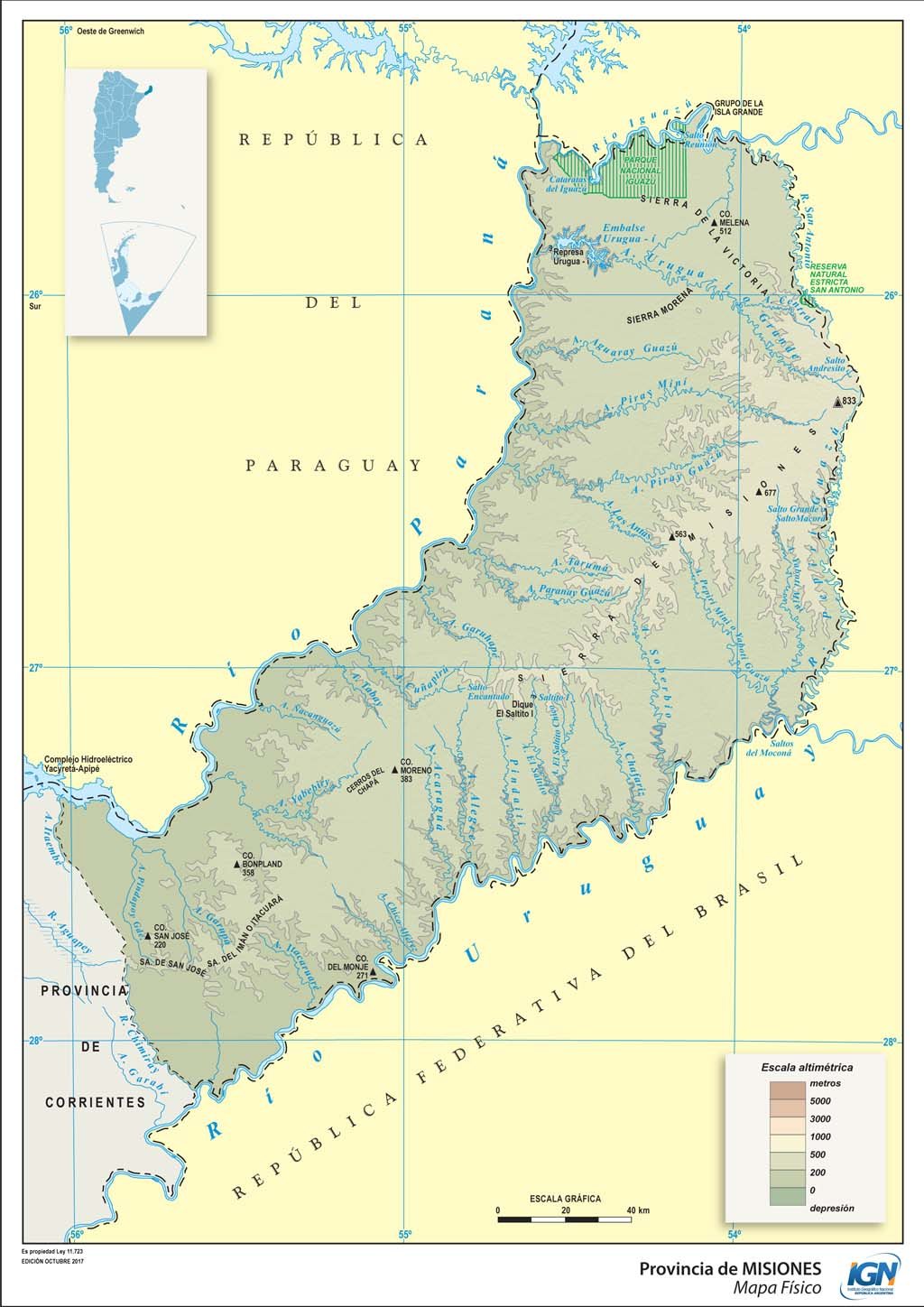
- Paraná · Uruguay · Iguazú
- Ecoregions
- Paraná Forest · Campos and Malezales
- Main cities
- Posadas · Oberá · Eldorado · Garupá · Puerto Iguazú
Sources: Secretaría de Infraestructura y Política Hídrica de la Nación, river basins · Ministerio de Ambiente de la Nación, ecoregions of Argentina · INDEC, 2022 National Census (population by department).
- Provincial flower
- Lapacho negro blossom · Ley XVI – N.º 91 (formerly Ley 4.318, 2006) · also a provincial natural monument
- Provincial natural monuments
- Jaguar, tapir and giant anteater · Ley XVI – N.º 22 (formerly Ley 2.589, 1988)
Paraná pine and palo rosa · Ley XVI – N.º 19 (formerly Ley 2.380, 1986)
Maned wolf and toco toucan · Ley XVI – N.º 75 (formerly Ley 4.083, 2004)
Saffron-cowled blackbird and strange-tailed tyrant · Ley XVI – N.º 79 (formerly Ley 4.138, 2004)
In all, 27 species have been declared provincial natural monuments: 16 of fauna and 11 of flora.
Sources: Ministerio de Ecología y Recursos Naturales Renovables de Misiones · Digesto Jurídico de Misiones.
- Hotel guests · 2024
- 784,605 in the surveyed towns: Puerto Iguazú 630,456 · Posadas 154,149 · 23.3 % from abroad
- National park
- Iguazú
Sources: INDEC and Secretaría de Turismo de la Nación, Hotel Occupancy Survey (hotels and other lodgings) · Administración de Parques Nacionales.
- Airports · passengers 2025
- Internacional de Puerto Iguazú/Mayor Carlos E. Krause 1,771,968 · Libertador General D. José de San Martín 330,379
- Scheduled flights · 2025
- Aeroparque 1,165,596 · Ezeiza 506,190 · Córdoba 51,806 · Salta 28,835 passengers
- National routes
- RN 12 · RN 14 · RN 101 · RN 105
- International border crossings
- Paraguay 20 (Posadas–Encarnación) · Brazil 16 (Bernardo de Irigoyen–Dionisio Cerqueira, Andresito–Capanema, Iguazú–Foz Do Iguaçu)
Sources: Secretaría de Turismo de la Nación, Air connectivity, with ANAC data · Instituto Geográfico Nacional (IGN), national road network and international crossings.
- From Posadas to the City of Buenos Aires, by road
- 1,040 km
To the other provincial capitals, by road
- Corrientes 315 km
- Resistencia 338 km
- Formosa 506 km
- Paraná 820 km
- Santa Fe 883 km
- Santiago del Estero 948 km
- La Plata 1,061 km
- San Miguel de Tucumán 1,106 km
- Salta 1,118 km
- San Fernando del Valle de Catamarca 1,160 km
- San Salvador de Jujuy 1,198 km
- Córdoba 1,213 km
- La Rioja 1,308 km
- San Luis 1,633 km
- Santa Rosa 1,660 km
- San Juan 1,758 km
- Mendoza 1,925 km
- Viedma 2,000 km
- Neuquén 2,198 km
- Rawson 2,495 km
- Río Gallegos 3,675 km
- Ushuaia 4,268 km
Source: Government of the Argentine Republic (argentina.gob.ar), road distances between provincial capitals.
- National festivals
- Fiesta Nacional del Inmigrante · September · Oberá
Fiesta Nacional de la Yerba Mate · November · Apóstoles
Sources: Ley nacional 25.931 · Ley nacional 27.060 · Honorable Cámara de Diputados de la Nación.
- Share of the national economy · 2024
- 1.3 % · rank 16 of 24
- Growth 2004–2024
- +39 % · the country, +42 %
- Main activities
- Trade 12.9 % · Paper 7.4 % · Public administration 7.1 % · Electric power 6.8 %
Source: ECLAC and Ministerio de Economía de la Nación, Provincial breakdown of gross value added, 2004 base (2023 and 2024, preliminary data).
Natural wealth
The territory that defines it
Misiones is rainforest. A wedge of red earth between the Paraná and Uruguay rivers, embraced by Brazil and Paraguay, which holds the largest remnant of Paraná Rainforest —the Atlantic Forest— in the country: giant trees, ferns, orchids, jaguars, toucans and hundreds of bird species. Almost a third of its territory is protected. Here water is the protagonist: it falls at the Iguazú Falls, runs along the longitudinal falls of Moconá and hides, crystallized, in the amethyst geodes of Wanda.
- Parque Nacional Iguazú (1934)
Source: Argentine National Parks Administration (SIB-APN).
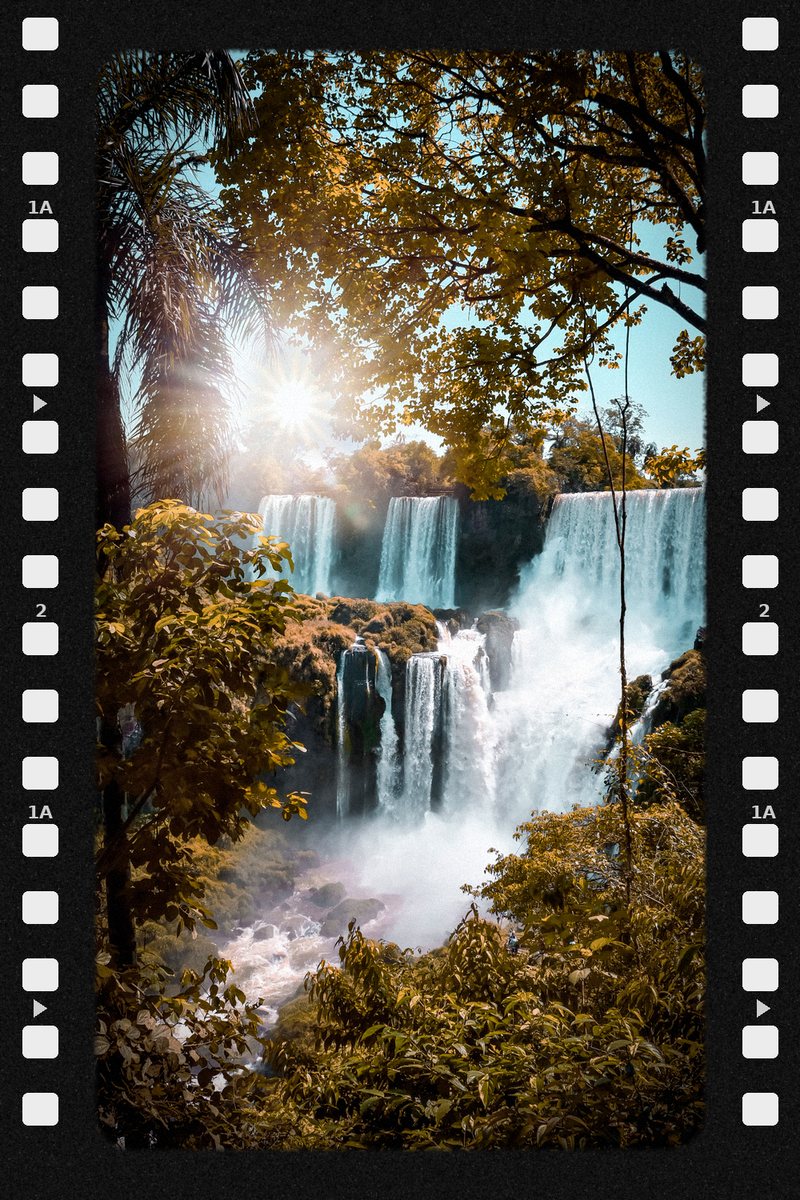
One of the largest waterfall systems on the planet: about 275 falls along almost three kilometers, 80 % of them on the Argentine side, with the Devil's Throat and its drop of more than 80 meters at its heart. Iguazú means "big water" in Guaraní. Iguazú National Park, created in 1934, protects about 67,000 hectares of rainforest; it was declared a World Heritage Site by UNESCO in 1984, and the Falls were chosen as one of the New Seven Wonders of Nature in 2011.
Sources: Argentine National Parks Administration · UNESCO · New7Wonders.
A UNESCO Biosphere Reserve since 1995, with about 253,000 hectares of Atlantic Forest in the departments of San Pedro and Guaraní, centered on the Esmeralda and Moconá provincial parks and home to Mbya Guaraní communities. On its edge, on the Uruguay River facing Brazil, the Moconá Falls —"the one that swallows everything", in Guaraní— fall parallel to the riverbed along almost two kilometers: one of the longest longitudinal waterfalls in the world, a National Natural Monument, visible only when the river is low.
Sources: Government of the Argentine Republic, Biosphere Reserves · Ministry of Ecology of Misiones · Instituto Nacional de Promoción Turística.
In the north of the province, in a colony founded by Polish immigrants, the basalt of Misiones holds geodes of amethyst, agate, jasper and rock crystal formed by ancient lava flows. Mined since the mid-20th century, today they can be visited in quarries and tunnels next to the workshops where the stones are cut and polished.
Sources: Directorate General of Mines and Geology of Misiones · Argentine Chamber of Deputies.
Human wealth
The living figures
Misiones speaks Guaraní. So say the names of its rivers, towns and falls, the round of mate that the province gave to the country, and the table: chipá, mbejú, sopa paraguaya and reviro, the rural worker's dish. On that root the immigrant colonies were added —Polish, Ukrainian, German, Swedish, Japanese— which Oberá celebrates at the National Immigrant Festival. Its music is polka, chamamé and the gualambao, born here.
- Before the conquest · the Guaraní inhabit the rainforest, grow cassava and corn and use the leaf of ka'a, yerba mate
- 17th and 18th centuries · the Jesuits organize the reductions together with the Guaraní: stone towns, music, printing and the first cultivated yerba mate plantations
- 1767 · the expulsion of the Jesuits leaves the towns abandoned
- 1815 to 1819 · Andrés Guacurarí y Artigas, Andresito, a Guaraní leader, governs Misiones as commander general
- 1881 · Misiones becomes a National Territory
- 1953 · Misiones becomes a province
Sources: UNESCO · Government of the Province of Misiones.
San Ignacio Miní, Santa Ana, Nuestra Señora de Loreto and Santa María la Mayor are the ruins of the reductions where the Guaraní and the Jesuits built temples of red sandstone with Guaraní Baroque as their hallmark. A UNESCO World Heritage Site since 1984, together with São Miguel das Missões, in Brazil. San Ignacio Miní, the most visited, can also be toured at night with a light and sound show.
Source: UNESCO, World Heritage List.
In Puerto Iguazú, where the Iguazú River flows into the Paraná, the Three Frontiers Landmark looks at Argentina, Brazil and Paraguay at once: Foz do Iguaçu and Ciudad del Este are in sight. It is one of the most vibrant meeting points in South America, joined by international bridges and by the same rainforest.
Source: Government of the Province of Misiones.
- Ramón Ayala, El Mensú · music · born in Garupá (1927-2023), creator of the gualambao, author of "El cosechero"
- Chango Spasiuk · music · accordionist born in Apóstoles, ambassador of the chamamé of Misiones
Sources: careers published in national and provincial press · Argentine Chamber of Deputies.
26,006 people identify as Indigenous or as descendants of Indigenous or native peoples: 2.0 % of the province's population. They belong to 41 different peoples, and 14,516 (55.8 %) speak or understand the language of their people. The five largest peoples are:
- Mbya Guaraní · 9,957
- Guaraní · 8,372
- Mapuche · 200
- Qom/Toba · 147
- Diaguita · 118
Source: INDEC, 2022 National Population, Household and Housing Census, final results. Population in private dwellings.
Productive wealth
What it produces and exports
Misiones is the province of infusions: it produces almost all of the country's yerba mate and tea. To that it adds the forestry industry —planted pines and eucalyptus, pulp and paper—, tobacco, citrus and cassava, and world-class tourism around Iguazú. Brazil is today its main export destination.
USD 533 million, 20.8 % more than in 2024: 0.6 % of the national total and 47.1 % of the Northeast.
- Manufactures of agricultural origin · USD 260 M
- Manufactures of industrial origin · USD 166 M
- Primary products · USD 107 M
Main destinations: Brazil (USD 130 M, 24.4 %), United States (USD 90 M), European Union (USD 79 M) and Middle East (USD 76 M). Main products: coffee, tea, yerba mate and spices (USD 162 M), paper, paperboard, printed matter and publications (USD 156 M), unmanufactured tobacco (USD 84 M) and cereals (USD 17 M).
Source: INDEC, Provincial origin of exports. Goods. Year 2025 (provisional data) and annex tables.
Public sector · in 2025, 889.3 million kilos of green leaf were processed in the country; Misiones contributed 83.2 %, according to the National Yerba Mate Institute (INYM). The Undersecretariat of Yerba Mate Affairs of Misiones reports 754.4 million kilos, 85 %, with more than 11,000 growers.
Misiones accounted for 87 % of the country's yerba mate exports: 52.4 million kilos to 50 markets, with Syria as the main destination. The province is part of the area of the Yerba Mate Argentina Geographical Indication (2016).
Sources: INYM, processed by the Centro de Economía Política Argentina (CEPA) · Undersecretariat of Yerba Mate Affairs of Misiones · Secretariat of Agriculture, Resolution 16/2016.
Argentina is the world's ninth tea producer and the first in the Americas; Misiones produces 95 % of the country's tea. The 2025/26 harvest closed with about 302,000 tonnes of shoots on about 29,000 hectares, with some 2,500 growers. 95 % is exported, mainly black tea, with the United States as the main buyer. INTA Cerro Azul holds the largest tea germplasm collection in South America.
Sources: Argentine Ministry of Agriculture · INTA · Ministry of Agriculture and Production of Misiones.
The forestry industry —planted pines and eucalyptus, sawmills, pulp and paper— is one of the pillars of the province: paper and paperboard accounted for USD 156 M in exports in 2025. The native rainforest also yields a rarity: the yacaratiá, a tree whose wood, after long cooking, becomes sweets and preserves. The development was validated at the Universidad Nacional de Misiones and declared of provincial interest in 2016.
Sources: INDEC, Provincial origin of exports 2025 · Universidad Nacional de Misiones · Chamber of Representatives of Misiones.
Unmanufactured tobacco accounted for USD 84 M of Misiones' exports in 2025, an increase of more than 200 % over 2024.
Source: INDEC, Provincial origin of exports 2025.
CONICET has three research units in the province, among them the Institute of Subtropical Biology (IBS), dedicated to the Paraná Rainforest, together with the Universidad Nacional de Misiones.
Source: CONICET, 2025 Management Report.
Space to embed one or more 45s–1min capsules about the province.
To experience it on the ground — restaurants, hotels, events, geolocation — the app.
Open the Argentina al Mundo app