San Luis
Explora Nuestras Provincias y sus Riquezas is part of Argentina al Mundo, alongside Argentine Delights, Guía AD-Gourmet and Chefs Argentinos al Mundo.
San Luis, the gateway to Cuyo. Its hills open into gorges and serene valleys, from Potrero de los Funes to Villa de Merlo, at the foot of the Comechingones. In Sierra de las Quijadas, red cliffs hold dinosaur tracks, and to the west, the salt flats shine under the sun. A land of faith that climbs to the Christ of La Quebrada every May, of Cuyo tonadas and of Pringles, hero of Independence. San Luis is not rushed: it is breathed. San Luis is the peace of the hills.

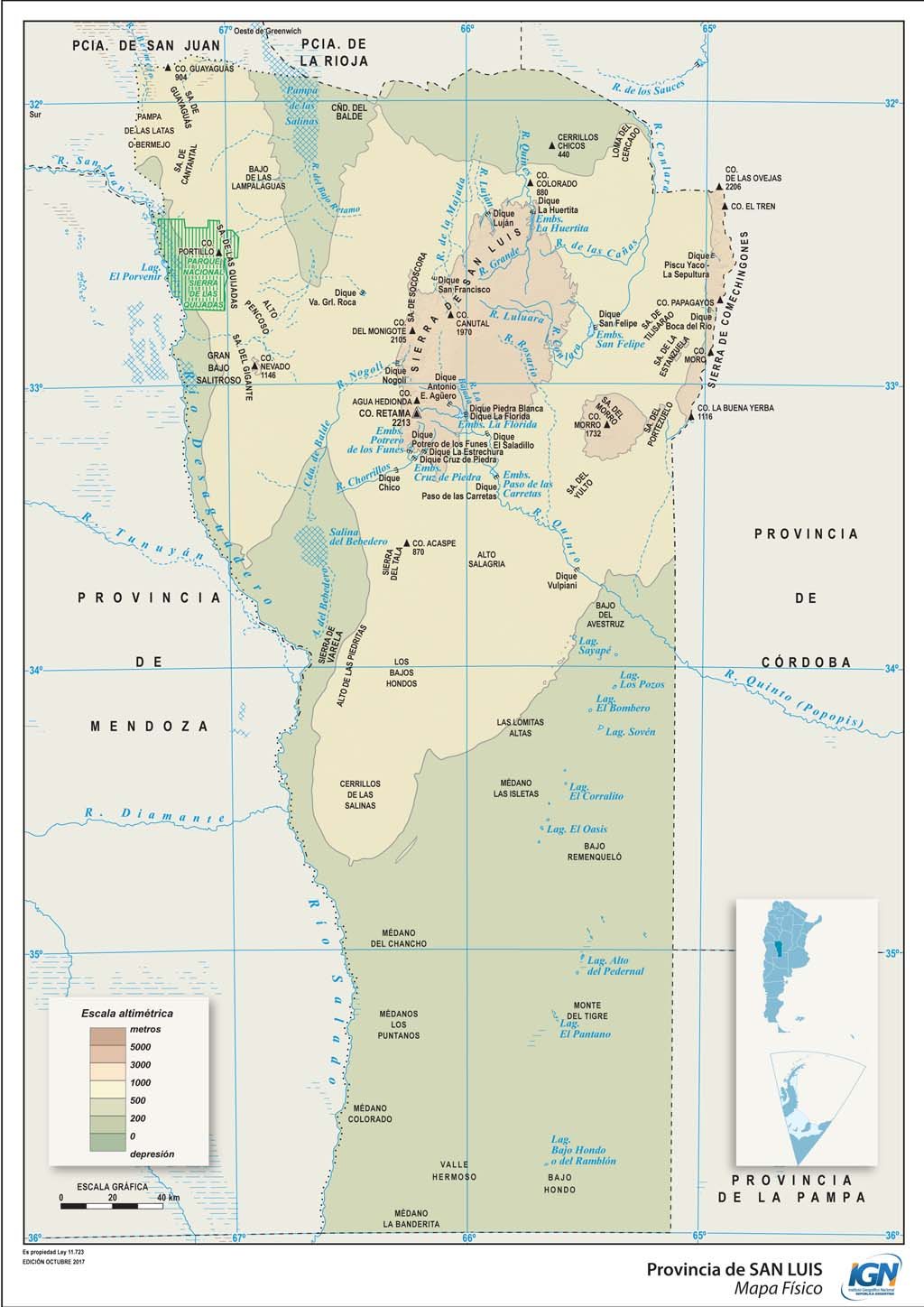
Political map · Source: IGN
- Capital
- San Luis
- Region
- Cuyo
- Area
- 76,748 km²
- Population · 2022 Census
- 542,069 inhabitants · 7.1 hab/km²
- Women · Men
- 51.1 % · 48.9 %
- Median age
- 31 years
- By age
- 0 to 14 years: 22.2 % · 15 to 64 years: 67.2 % · 65 years and over: 10.6 %
- Climate
- Semi-arid temperate; highland climate in the sierras; more humid towards the east.
- Demonym
- puntano/a
- Founding of the capital
- 25 August 1594
- Status
- Province predating the 1853 National Constitution
- Departments
- 9
- Born in another province · abroad
- 27.6 % · 1.5 %
Sources: INDEC, 2022 National Census (final results) · INDEC / IGN (area) · Provincialization laws · IGN (political division).
- Mean annual temperature
- 17.6 °C
- Annual rainfall
- 667 mm
- Mean maximum · warmest month
- 31.6 °C · January
- Mean minimum · coldest month
- 4.0 °C · July
Source: Servicio Meteorológico Nacional (SMN), climatological standard normals 1991–2020, station San Luis Aero, submitted to the World Meteorological Organization.
- Highest point
- Cerro de las Ovejas · 2,297 m · in the Sierras de Comechingones, on the border with Córdoba
- Main rivers
- Quinto · Conlara · Desaguadero
- Ecoregions
- Dry Chaco · Espinal · Monte of Plains and Plateaus · Pampas
- Main cities
- San Luis · Villa Mercedes · Merlo · Juana Koslay · La Punta
Sources: Government of the Argentine Republic (argentina.gob.ar) · Secretaría de Infraestructura y Política Hídrica de la Nación, river basins · Ministerio de Ambiente de la Nación, ecoregions of Argentina · INDEC, 2022 National Census (population by department).
- Provincial natural monument
- Pampas deer · provincial natural monument · also protected by Ley IX-0311-2004
Sources: Ministerio de Ambiente de la Nación, species fact sheet · Legislatura de San Luis.
- Hotel guests · 2024
- 223,502 in the surveyed towns: Villa de Merlo 123,522 · San Luis 99,980 · 2.4 % from abroad
- National park
- Sierra de las Quijadas
Sources: INDEC and Secretaría de Turismo de la Nación, Hotel Occupancy Survey (hotels and other lodgings) · Administración de Parques Nacionales.
- Airports · passengers 2025
- Brigadier Mayor D. César Raúl Ojeda 57,063 · Internacional Valle del Conlara 13,586
- Scheduled flights · 2025
- Aeroparque 57,063 passengers
- National routes
- RN 7 · RN 8 · RN 20 · RN 79 · RN 146 · RN 147 · RN 188
Sources: Secretaría de Turismo de la Nación, Air connectivity, with ANAC data · Instituto Geográfico Nacional (IGN), national road network and international crossings.
- From San Luis to the City of Buenos Aires, by road
- 790 km
To the other provincial capitals, by road
- Mendoza 260 km
- San Juan 320 km
- Córdoba 420 km
- Santa Rosa 505 km
- La Rioja 550 km
- Santa Fe 625 km
- Paraná 656 km
- San Fernando del Valle de Catamarca 705 km
- Santiago del Estero 850 km
- Neuquén 883 km
- La Plata 894 km
- San Miguel de Tucumán 938 km
- Viedma 1,099 km
- Salta 1,245 km
- Resistencia 1,295 km
- Corrientes 1,318 km
- San Salvador de Jujuy 1,320 km
- Rawson 1,360 km
- Formosa 1,463 km
- Posadas 1,633 km
- Río Gallegos 2,540 km
- Ushuaia 3,133 km
Source: Government of the Argentine Republic (argentina.gob.ar), road distances between provincial capitals.
- National festivals
- Fiesta Nacional de la Calle Angosta · Villa Mercedes
- Traditional festivals
- Fiesta del Señor de Renca · 3 May
Sources: Res. Secretaría de Turismo de la Nación 899/1994 · Ley provincial 1.191.
- Share of the national economy · 2024
- 0.9 % · rank 20 of 24
- Growth 2004–2024
- +24 % · the country, +42 %
- Main activities
- Trade 12.6 % · Food and beverages 10.0 % · Agriculture and livestock 8.4 % · Chemicals 6.7 %
Source: ECLAC and Ministerio de Economía de la Nación, Provincial breakdown of gross value added, 2004 base (2023 and 2024, preliminary data).
Natural wealth
The territory that defines it
San Luis is the hinge between Cuyo and the pampa plains. In its center and north rise the Sierras de San Luis and, to the east, the Comechingones, with Villa de Merlo, the Conlara valleys and dams such as Potrero de los Funes. To the northwest, Sierra de las Quijadas National Park unfolds an amphitheater of red cliffs where fossils of dinosaurs and of Pterodaustro, a Cretaceous pterosaur, were found. To the west, the Salinas del Bebedero and the Desaguadero lagoons form part of the Ramsar site it shares with Mendoza and San Juan; to the south, the caldén forest opens toward the pampa.
- Parque Nacional Sierra de las Quijadas (1991)
Source: Argentine National Parks Administration (SIB-APN).
- Lagunas de Guanacache, Desaguadero y del Bebedero (1999; extended in 2007) · 962,370 ha · shared with Mendoza and San Juan
Source: Argentine Undersecretariat of Environment, Ramsar Sites Network. Official year of designation and area.
Human wealth
The living figures
San Luis is faith, hills and tradition. Every May, thousands of pilgrims climb to the Christ of La Quebrada, in Villa de la Quebrada; Villa Mercedes celebrates the National Calle Angosta Festival, born of the Cuyo tonada, and Villa de Merlo welcomes tourists all year round. At the table, kid goat, San Luis empanadas, homemade sweets and beef from its fields.
- Before the conquest · the Comechingón in the hills, the Huarpe in the lagoons of the west and the Ranquel in the south
- 1594 · Luis Jufré de Loaysa y Meneses founds San Luis de Loyola Nueva Medina de Río Seco
- 1816-1817 · San Luis contributes men, horses and resources to San Martín's Army of the Andes
- 1820 · Juan Pascual Pringles, from San Luis, stars at Chancay, in Peru, in one of the most remembered episodes of the liberation campaign
Sources: Government of the Province of San Luis · Instituto Nacional Sanmartiniano.
8,340 people identify as Indigenous or as descendants of Indigenous or native peoples: 1.5 % of the province's population. They belong to 42 different peoples, and 866 (10.4 %) speak or understand the language of their people. The five largest peoples are:
- Huarpe · 1,322
- Comechingón · 1,274
- Ranquel · 1,012
- Mapuche · 652
- Guaraní · 369
Source: INDEC, 2022 National Population, Household and Housing Census, final results. Population in private dwellings.
Productive wealth
What it produces and exports
San Luis combines a strong industrial profile, born of the industrial promotion of the 1980s and 1990s, with expanding agriculture —corn and soybeans on the plains of the east and south— and cattle breeding and fattening. Cereals lead its exports, and the Middle East and Chile are its main destinations.
USD 686 million, 2.0 % more than in 2024: 0.8 % of the national total and 15.9 % of Cuyo.
- Primary products · USD 370 M
- Manufactures of agricultural origin · USD 179 M
- Manufactures of industrial origin · USD 138 M
Main destinations: Middle East (USD 77 M, 11.2 %), Chile (USD 77 M), China (USD 59 M) and Vietnam (USD 49 M). Main products: cereals (USD 296 M), oilseeds and oleaginous fruits (USD 69 M), meat and meat preparations (amount withheld for statistical confidentiality) and vegetable, pulse and fruit preparations (USD 37 M).
Source: INDEC, Provincial origin of exports. Goods. Year 2025 (provisional data) and annex tables.
1,336,277 head as of 31 December 2024: 2.6 % of the national cattle stock.
Source: SENASA, stock as of 31/12/2024, in Secretariat of Agriculture, Provincial cattle profile 2024.
CONICET has five research units in the province, together with the Universidad Nacional de San Luis.
Source: CONICET, 2025 Management Report.
Space to embed one or more 45s–1min capsules about the province.
To experience it on the ground — restaurants, hotels, events, geolocation — the app.
Open the Argentina al Mundo app