Tucumán
Explora Nuestras Provincias y sus Riquezas is part of Argentina al Mundo, alongside Argentine Delights, Guía AD-Gourmet and Chefs Argentinos al Mundo.
Tucumán, the Garden of the Republic. In its historic center beats the House where Independence was declared, in 1816. And within minutes, the peaceful city gives way to the yunga: a road that winds between forests and clouds up to Tafí del Valle, a paradise among mountains, of ancient menhirs and cheeses with history. Lemons, sugarcane, empanadas that are a national pride and the eternal voice of Mercedes Sosa. Tucumán cannot be explained: it must be lived. Tucumán is the homeland in bloom.

Political map · Source: IGN
- Capital
- San Miguel de Tucumán
- Region
- Northwest
- Area
- 22,524 km²
- Population · 2022 Census
- 1,731,820 inhabitants · 76.9 hab/km²
- Women · Men
- 51.5 % · 48.5 %
- Median age
- 30 years
- By age
- 0 to 14 years: 23.2 % · 15 to 64 years: 66.3 % · 65 years and over: 10.5 %
- Climate
- Subtropical with a dry season; humid in the yungas; temperate in the high valleys.
- Demonym
- tucumano/a
- Founding of the capital
- 31 May 1565 (in Ibatín; moved to its current site in 1685)
- World Heritage (UNESCO)
- Qhapaq Ñan, Sistema Vial Andino (2014)
- Status
- Province predating the 1853 National Constitution
- Departments
- 17
- Born in another province · abroad
- 10.6 % · 0.7 %
Sources: INDEC, 2022 National Census (final results) · INDEC / IGN (area). World Heritage: UNESCO, World Heritage List · Provincialization laws · IGN (political division).
- Mean annual temperature
- 19.8 °C
- Annual rainfall
- 1,010 mm
- Mean maximum · warmest month
- 31.3 °C · January
- Mean minimum · coldest month
- 6.9 °C · July
Source: Servicio Meteorológico Nacional (SMN), climatological standard normals 1991–2020, station Tucumán Aero, submitted to the World Meteorological Organization.
- Highest point
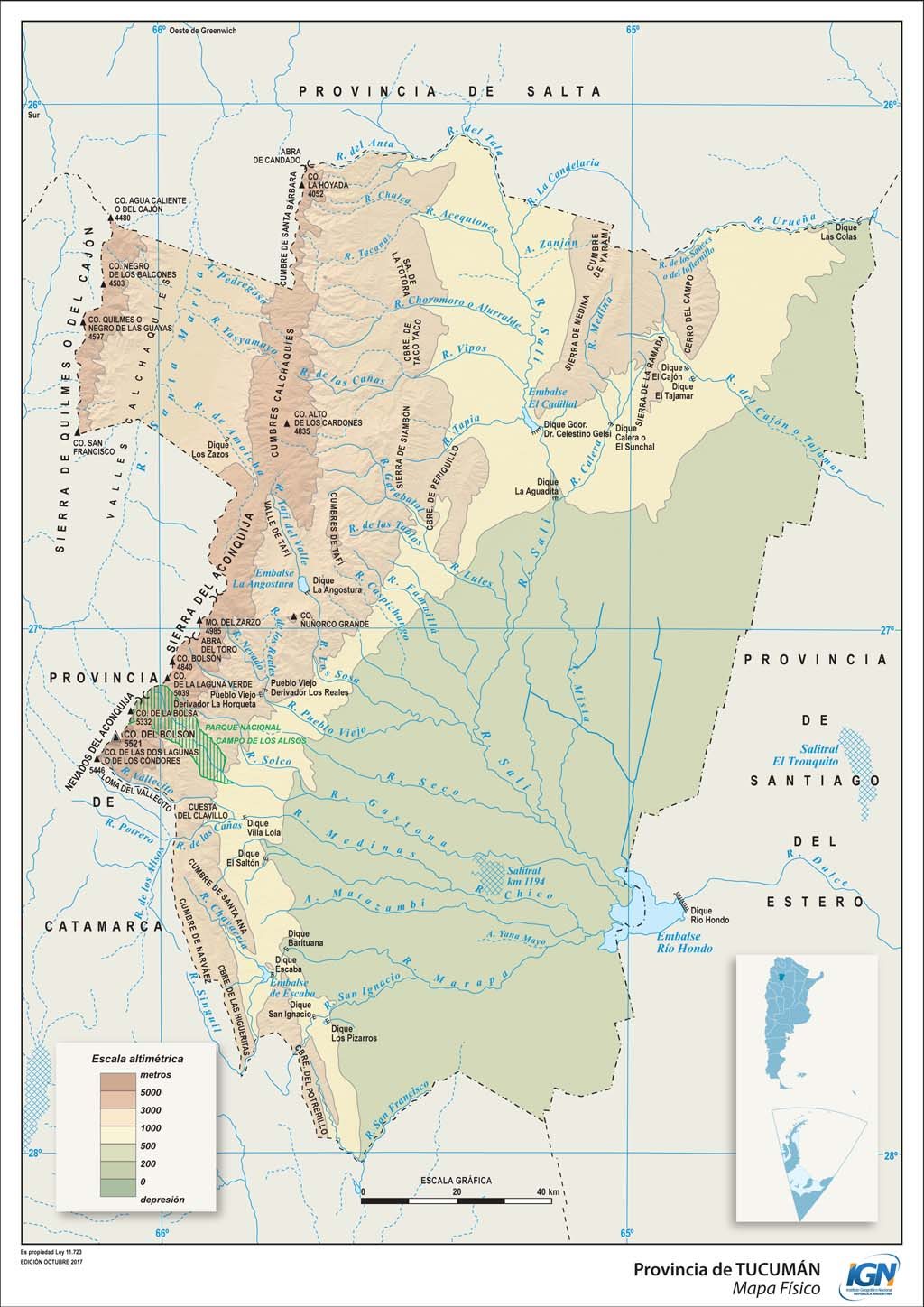
- Cerro del Bolsón · 5,552 m · in the Sierras del Aconquija, on the border with Catamarca
- Main rivers
- Salí · Lules · Gastona · Medina · Marapa
- Ecoregions
- High Andes · Monte of Sierras and Bolsones · Yungas Forest · Dry Chaco
- Main cities
- San Miguel de Tucumán · Yerba Buena · Tafí Viejo · Banda del Río Salí · Concepción
Sources: Government of the Argentine Republic (argentina.gob.ar) · Secretaría de Infraestructura y Política Hídrica de la Nación, river basins · Ministerio de Ambiente de la Nación, ecoregions of Argentina · INDEC, 2022 National Census (population by department).
- Best time to visit
- Autumn (March to May) and spring (September to November), for its mild climate
Source: Ente Autárquico Tucumán Turismo.
- Provincial natural monument
- Tapir · Ley 9.985 (2026)
Sources: Legislatura de Tucumán.
- Hotel guests · 2024
- 191,924 in San Miguel de Tucumán · 5.0 % from abroad
- National park
- Aconquija
Sources: INDEC and Secretaría de Turismo de la Nación, Hotel Occupancy Survey (hotels and other lodgings) · Administración de Parques Nacionales.
- Airport
- Internacional Teniente General Benjamín Matienzo · 861,334 passengers in 2025
- Scheduled flights · 2025
- Aeroparque 605,206 · Ezeiza 188,488 · Córdoba 34,170 · Punta Cana 12,548 passengers
- National routes
- RN 9 · RN 34 · RN 38 · RN 40 · RN 65 · RN 157
Sources: Secretaría de Turismo de la Nación, Air connectivity, with ANAC data · Instituto Geográfico Nacional (IGN), national road network and international crossings.
- From San Miguel de Tucumán to the City of Buenos Aires, by road
- 1,203 km
To the other provincial capitals, by road
- Santiago del Estero 160 km
- San Fernando del Valle de Catamarca 232 km
- Salta 307 km
- San Salvador de Jujuy 340 km
- La Rioja 388 km
- Córdoba 590 km
- Resistencia 765 km
- Santa Fe 767 km
- Corrientes 791 km
- Paraná 798 km
- San Juan 838 km
- Formosa 936 km
- San Luis 938 km
- Mendoza 1,005 km
- Posadas 1,106 km
- Santa Rosa 1,190 km
- La Plata 1,309 km
- Viedma 1,784 km
- Neuquén 1,860 km
- Rawson 2,045 km
- Río Gallegos 3,225 km
- Ushuaia 3,818 km
Source: Government of the Argentine Republic (argentina.gob.ar), road distances between provincial capitals.
- National festivals
- Fiesta Nacional de la Empanada · September · Famaillá
Sources: Honorable Cámara de Diputados de la Nación.
- Share of the national economy · 2024
- 1.9 % · rank 8 of 24
- Growth 2004–2024
- +50 % · the country, +42 %
- Main activities
- Trade 17.8 % · Public administration 9.5 % · Food and beverages 8.3 % · Agriculture and livestock 7.6 %
Source: ECLAC and Ministerio de Economía de la Nación, Provincial breakdown of gross value added, 2004 base (2023 and 2024, preliminary data).
Natural wealth
The territory that defines it
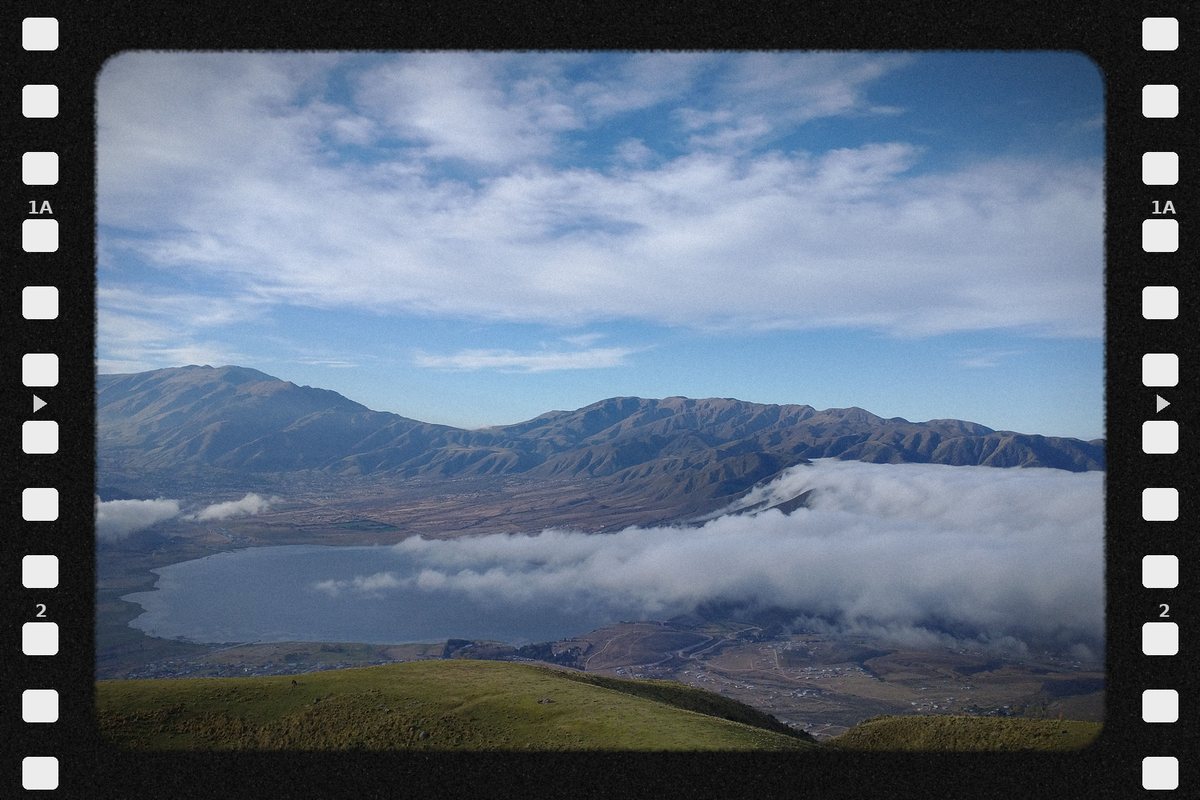
Tucumán is the smallest province in the country and one of the most intense: within a few kilometers it goes from the sugarcane plains to the mountain rainforest and the peaks of the Aconquija, which exceed 5,000 meters. Its Yungas, green all year round, earned it the name of Garden of the Republic. Behind the mountains lie the Tafí valley, with its high-altitude meadows, and the Calchaquí Valleys, dry and luminous, from Amaicha to Colalao del Valle.
- Parque Nacional Aconquija (2018)
Source: Argentine National Parks Administration (SIB-APN).
The mountain rainforest wraps the eastern slopes of the province: cloud forests, ferns, lianas and waterfalls that stay green all year and give Tucumán its name of Garden of the Republic. Minutes from the capital, the Sierra de San Javier, with the biological park of the Universidad Nacional de Tucumán, opens the forest to hikers and paragliders; further south, Aconquija National Park protects the complete gradient, from the rainforest to peaks above 5,000 meters.
Sources: Argentine National Parks Administration · Universidad Nacional de Tucumán.
After climbing the slope through the rainforest, the road opens onto a high valley at about 2,000 meters, of green meadows, mountains and the waters of the La Angostura dam. It is the land of the menhirs of the Tafí culture, of estancias of Jesuit origin, such as La Banda, now a museum, and of a centuries-old cheesemaking tradition celebrated every year at the National Cheese Festival.
Source: Ente Autárquico Tucumán Turismo.
Human wealth
The living figures
Tucumán is the cradle of Independence: Argentina was born in its Historic House. Its identity blends the Diaguita heritage of the valleys with the culture of the sugar mill and the harvest, which for more than a century shaped the life of the province. At the table, the Tucumán empanada reigns, with its knife-cut filling and its own national festival in Famaillá, alongside quesillo cheese and the sweets of the valleys. And in music, the zamba and the chacarera found some of their greatest voices in Tucumán.
- More than 2,000 years ago · farming peoples of the Tafí valley raise the menhirs: about 50 carved stones up to three meters high, now gathered in El Mollar
- 16th and 17th centuries · the Quilmes, a Diaguita people, resist the conquest from their city in the Calchaquí Valleys, the largest pre-Hispanic settlement in the country. In 1667 they are defeated and exiled on foot to the outskirts of Buenos Aires, where the city that bears their name stands today
- 1565 · San Miguel de Tucumán is founded in Ibatín; in 1685 it moves to its current site
- 1812 · the Battle of Tucumán, decisive in the War of Independence
- 9 July 1816 · the Congress gathered in the Historic House of Tucumán declares Argentine Independence
Sources: Ente Autárquico Tucumán Turismo · Universidad Nacional de Río Cuarto, Cultura en Red (2024).
In the house of Francisca Bazán de Laguna, the Congress declared Independence on 9 July 1816. In the early 20th century everything was demolished except the Hall of the Oath, which was protected inside a French-style pavilion: that contrast gave rise to the nickname "the Little House of Tucumán". Declared a National Historic Monument in 1941, it was rebuilt in 1943 by the architect Mario Buschiazzo on its original foundations, based on a photograph taken by Ángel Paganelli in 1869.
Today it houses the Museo Casa Histórica de la Independencia. Since 1992, every 9 July Tucumán is the capital of the Republic and the House hosts the main ceremony for Independence Day.
Sources: Museo Casa Histórica de la Independencia · Anuario IEHS, Universidad Nacional del Centro (1943 reconstruction).
- Mercedes Sosa · music · born in San Miguel de Tucumán (1935-2009), the voice of Latin America
- Juan Falú · music · guitarist and composer from Tucumán
- Tomás Eloy Martínez · literature · born in San Miguel de Tucumán (1934-2010)
Sources: careers published in national and provincial press.
37,646 people identify as Indigenous or as descendants of Indigenous or native peoples: 2.2 % of the province's population. They belong to 39 different peoples, and 6,504 (17.3 %) speak or understand the language of their people. The five largest peoples are:
- Diaguita · 20,096
- Kolla · 503
- Quechua · 442
- Lule · 437
- Guaraní · 326
Source: INDEC, 2022 National Population, Household and Housing Census, final results. Population in private dwellings.
Productive wealth
What it produces and exports
Tucumán is the agro-industrial heart of the Northwest. Sugarcane, with its mills and bioethanol distilleries, and lemons, from which concentrated juice, essential oil and dehydrated peel are made for the world, are its two great value chains, together with strawberries, blueberries and avocados. The European Union is today its main export destination.
USD 967 million, 3.9 % more than in 2024: 1.1 % of the national total and 19.3 % of the Northwest.
- Manufactures of agricultural origin · USD 373 M
- Manufactures of industrial origin · USD 335 M
- Primary products · USD 257 M
- Fuels and energy · USD 2 M
Main destinations: European Union (USD 297 M, 30.7 %), United States (USD 222 M), Brazil (USD 112 M) and Chile (USD 84 M). Main products: chemicals and related products (USD 205 M), vegetable, pulse and fruit preparations (USD 140 M), fresh fruit (USD 136 M) and sugar, cocoa and confectionery (USD 131 M).
Source: INDEC, Provincial origin of exports. Goods. Year 2025 (provisional data) and annex tables.
14 sugar mills. 2025 harvest: 17,640,452 tonnes of cane crushed and 1,303,169 tonnes of physical sugar, with a record crush.
Private sector · the Centro Azucarero Argentino records a matching figure for Tucumán's mills: 1,305,236 tonnes.
Sources: Public sector, Instituto de Promoción del Azúcar y Alcohol de Tucumán (IPAAT) · Private sector, Centro Azucarero Argentino.
Tucumán is the world's leading producer, processor and exporter of industrial lemon derivatives —concentrated juice, essential oil and dehydrated peel— and the world's second exporter of fresh lemons. In 2025 the lemon complex exported USD 510 M, originating in the Northwest.
Private sector · San Miguel, founded in Tucumán in 1954, processes more than 340,000 tonnes of lemons a year at its plants in Famaillá, Uruguay and South Africa, and accounts for about 15 % of world production of natural lemon ingredients. According to the company, Argentina holds 60 % of that global market.
Sources: Public sector, Instituto de Desarrollo Productivo de Tucumán (IDEP) · Argentine Ministry of Economy, Lemon value chain (2025) · INDEC, export complexes 2025 · Private sector, San Miguel S.A.
The first Argentine dairy product with a Geographical Indication, recognized by Resolution 31/2026 of the Secretariat of Agriculture, after more than 20 years of work by the Universidad Nacional de Tucumán with the producers. It is made with cow's milk from herds in Tafí del Valle and El Mollar, aged for at least 30 days. Its tradition dates back to the Jesuits of the 18th century, and among its historic producers is Estancia Las Carreras, home of the well-known M cheese.
Sources: Secretariat of Agriculture, Livestock and Fisheries, Resolution 31/2026 · Universidad Nacional de Tucumán · Ente Autárquico Tucumán Turismo.
With 17 CONICET research units, Tucumán is the main scientific hub of northern Argentina, together with the Universidad Nacional de Tucumán and the Estación Experimental Agroindustrial Obispo Colombres (EEAOC), a benchmark in sugarcane and citrus.
Sources: CONICET, 2025 Management Report · EEAOC.
Space to embed one or more 45s–1min capsules about the province.
To experience it on the ground — restaurants, hotels, events, geolocation — the app.
Open the Argentina al Mundo app